Skip to content
Agent as a Service · on your own server

Everyone fixes. Engineers review.

QA, designers, product and support raise a bug or a change in plain words. Fixroom's agents find the cause, write the change, run your tests and open a pull request. Your engineers review it, and only a person merges.

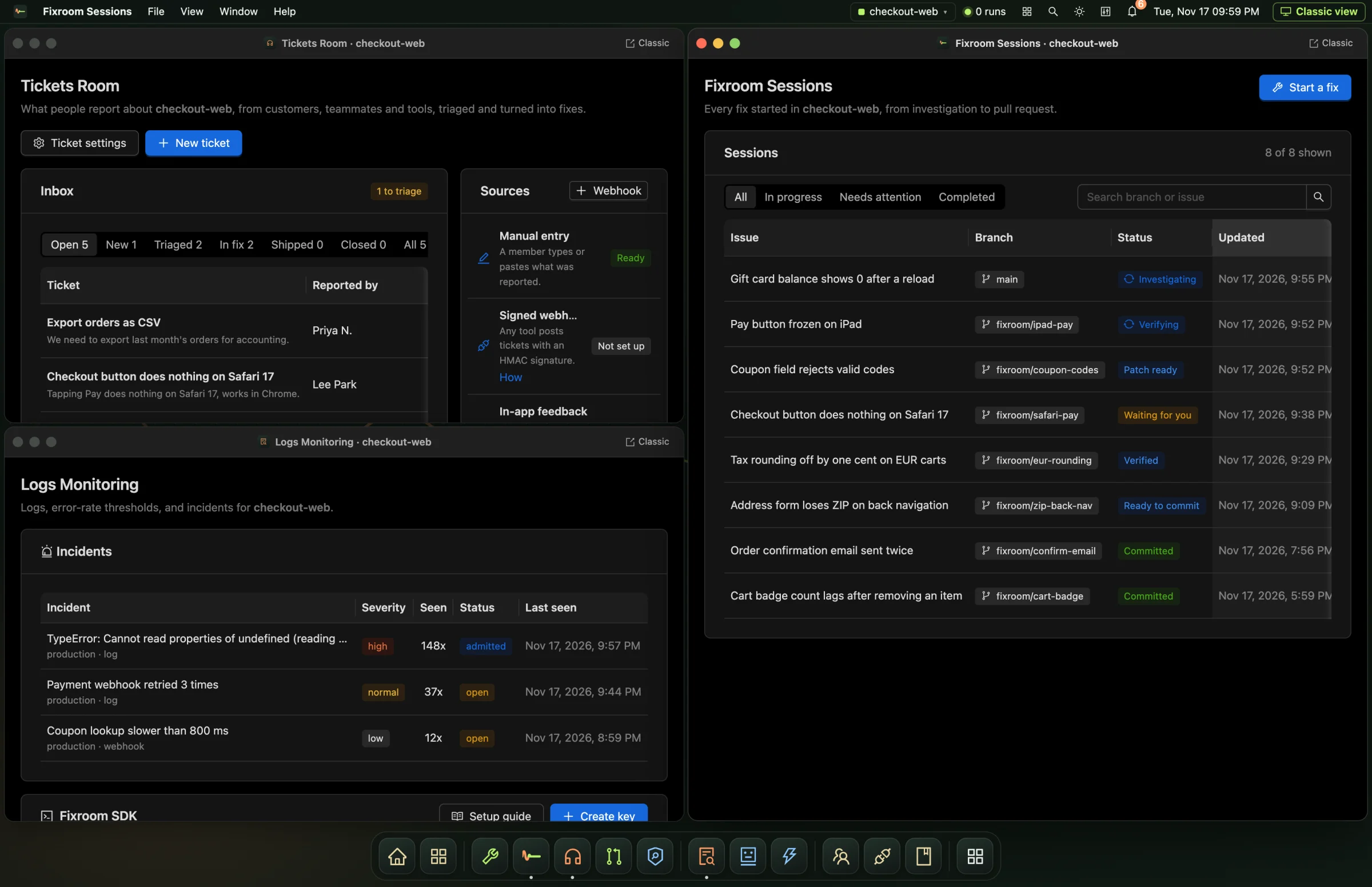
Fixroom OS with Tickets Room, Logs Monitoring and Fixroom Sessions open side by side for a project called checkout-web
1
install for tickets, logs, fixes, review and scanning
0
merge operations in the code: a person always merges
5
SDK languages for your logs, served by your own host
Anyone can contribute

Whoever finds the problem can fix it. Engineers review it.

Most fixes wait in a queue until an engineer has time to write them. In Fixroom, the person who spots the problem starts the fix, the agents write it and run your tests, and engineers spend their time on the review only they can do.
Finds a bug, starts the fix

QA

Files the failing case as a ticket and opens a fix session from it. Fixroom finds the cause, stages the change and runs the test suite.

Asks for a change in plain words

Design and product

A wrong label, a spacing that's off, a small feature. An improvement session turns the request into acceptance criteria and a staged change.

Report it where they already are

Support and customers

Help desks, a support mailbox, Slack, Discord and the in-app widget all land in Tickets Room, grouped and ready to triage.

Review, then merge

Engineers

Every change arrives as a pull request with your tests already run and Fixroom's AI review on it. An engineer reads it and decides.

  1. Anyone raises it
  2. Agents write the change
  3. Your tests run
  4. Pull request opens
  5. An engineer reviews and merges

Who can do what

How it works

From report to merged fix, in five steps.

Your AI model · only the calls you configure01DescribeAnyone, or a signalSays what the customersees, in plain words.02InvestigateThe agentReads the code, changesnothing. Proposes a fix.03ReviewThe contributorReads the proposed changeand applies it.04VerifyYour serverYour own checks runon the applied change.05ShipThe contributorOpens the pull request. Fixroomhas no way to merge it.Your serverReports inTickets, chat,errors, peopleTo GitHubAn engineerreviews, merges
People decideThe agent proposesYour server runs itThe route a fix takes

Fixroom · Sheet A-1 · How a fix moves · Business view, not to scale

  1. 01DescribeAnyone describes it, or a ticket, signal or log spike opens it.
  2. 02InvestigateThe model reads the repo with read-only tools.
  3. 03ReviewThe contributor reads a staged diff. Nothing is written yet.
  4. 04VerifyThe patch is applied and your checks run.
  5. 05ShipA pull request opens. An engineer reviews and merges.

Watch a full fix session

Why Fixroom

The market sells this in pieces. Fixroom is the whole loop.

$1B

Two AI SRE tools that investigate incidents were each valued at a billion dollars in 2026. Fixroom investigates too, then writes and tests the fix as a pull request.

Enterprise

That's the tier where most review and agent tools put self-hosting. Fixroom is self-hosted from the first install.

1 of ~30

Of about 30 products we reviewed, one took support tickets in. Fixroom takes them from help desks, email, Slack and Discord.

See the research and sources

Let your whole team fix. Keep engineers on review.

Runs on your own server with the model you already pay for. An engineer reviews every change before it merges.